

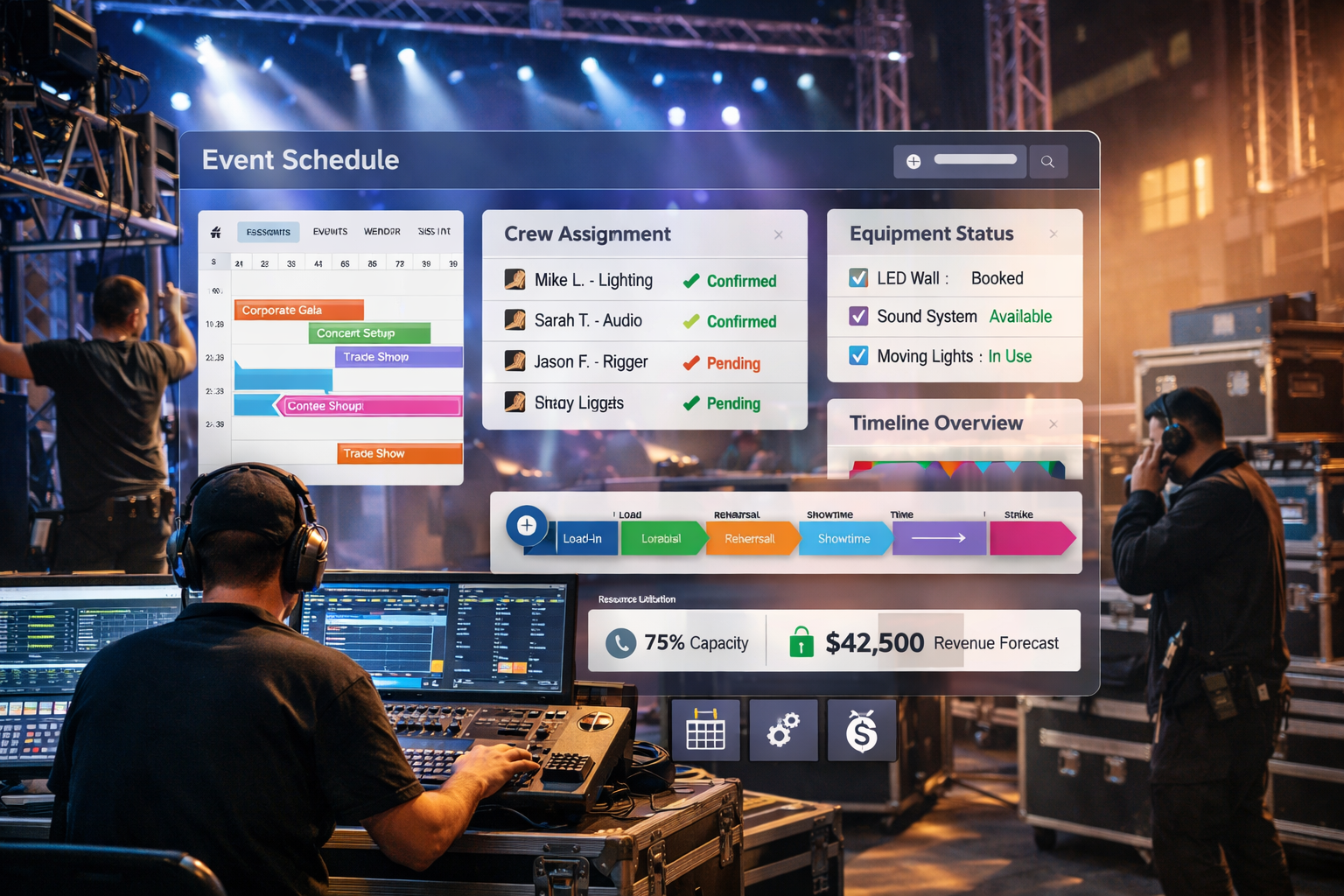
Event Production Scheduling Software: The Modern Approach to Managing Crew, Gear & Timelines
In the world of event production, success hinges on precision. Load-ins, rehearsals, show calls, and load-outs all have to happen on time, with the right crew, equipment, and assets in the right place. Yet most event companies are still juggling schedules using spreadsheets, text threads, Google Calendar, shared docs, and endless last-minute confirmations.
This fragmented approach creates the silent margin killer in the industry: scheduling chaos.
Why Scheduling Breaks Down in Event Production
Event production companies aren’t just managing events — they’re managing resources. At the core, there are three moving pieces:
People (AV techs, stagehands, lighting designers, freelancers, production managers)
Equipment (lighting rigs, audio systems, LED walls, consoles, trusses, trucks, lifts)
Timelines (load-in → rehearsal → show → strike)
Traditional tools like spreadsheets or generic project management software fail because they don’t understand resource constraints. They can’t answer critical operational questions such as:
Who is available for a show call on Thursday?
Do we have enough LED panels for the weekend?
Is our lighting rig already booked for another event?
Can we take on another gig next month without overworking the crew?
Are freelancers confirmed and assigned?
And as companies scale, these inefficiencies compound.
The Cost of Manual Scheduling
Without the right scheduling workflow, production teams face:
✅ double-booked equipment
✅ overworked crew members
✅ idle assets during high demand periods
✅ miscommunication between departments
✅ delayed invoicing and billing errors
✅ client delivery risks
Margins shrink not because of lack of gigs, but because resource management isn’t optimized.
This is why many event production companies are now adopting event production scheduling software — tools built specifically to handle equipment booking, crew scheduling, timeline planning, and resource forecasting.
Resource-Driven Scheduling: The New Standard
Instead of planning around events alone, modern scheduling is resource-centric. With a resource-driven model:
✔ events are containers
✔ equipment and crew are constraints
✔ schedules are dynamic
✔ forecasting becomes possible
This shift allows production companies to:
reduce last-minute rentals
utilize internal gear more effectively
optimize freelancer scheduling
align budgets with actual usage
expand capacity without expanding payroll
Crew Scheduling & Freelancer Management
The freelancer workforce is essential in event production, yet is notoriously difficult to schedule. Event crew scheduling software helps production managers:
track availability
assign shifts
confirm bookings
handle rate differences
manage billing and payroll data
integrate calendars
With freelancers able to see their upcoming work, confirmations happen faster and crew communication friction drops dramatically.
Equipment & Asset Scheduling
Unlike generic tools, event-focused schedulers manage:
LED walls
audio packages
lighting rigs
trusses
lifts
generators
media assets
trucks
cases and cable packages
Preventing equipment conflicts is one of the highest ROI scheduling optimizations in production companies, because it avoids:
🚫 unnecessary rentals
🚫 missed shows
🚫 delayed load-ins
This directly protects margin.
Timeline Planning: Load-ins, Show Calls, and Strikes
Event production is not a single moment in time — it’s a timeline of phases. Scheduling tools built for production allow separate planning for:
load-in
setup
tech rehearsal
FOH arrival
show call
strike
load-out
Each phase consumes different resources at different times. A visual production calendar or resource timeline becomes essential for operational clarity and forecasting.
Forecasting Capacity & Revenue
The most forward-thinking production houses use schedulers not just for logistics but for capacity planning and revenue forecasting.
With visibility into resource utilization, companies can answer:
“Can we take on more gigs next month?”
and just as importantly:
“Should we hire or rent for the upcoming season?”
Production companies that forecast correctly are able to scale without chaos.
Where Kolapp Fits In
Kolapp is built specifically for resource-intensive industries like event production. With Kolapp, teams can:
✔ schedule crew, equipment, and events in one platform
✔ view availability in real time
✔ prevent equipment double-booking
✔ assign freelancers with rate tracking
✔ manage billable vs. non-billable hours
✔ sync calendars (Outlook / Google)
✔ export usage for billing & invoicing
✔ forecast capacity and resource utilization
For production companies managing 10–500 events per year, Kolapp eliminates the operational friction that quietly drains margin.
The Result: More Events, Less Stress, Higher Margin
When scheduling becomes intelligent, production companies:
💰 increase throughput
💰 reduce last-minute rentals
💰 avoid schedule collisions
💰 improve freelancer relationships
💰 speed up invoicing
💰 gain competitive advantage
Scaling then becomes strategic instead of reactive.
Conclusion
Event production is complex and resource-heavy. Companies that modernize their event production scheduling workflows will outcompete those still relying on spreadsheets and manual confirmations.
As the industry demands more shows, tighter turnarounds, and more freelancers, the companies that adopt event production scheduling software will be positioned to grow margin, not just revenue.